Wednesday, January 1, 2020

The Outdoors as Stress Therapy

Submitted to Piney Woods Journal in 2019 
Many Americans experience high levels of stress in pressure-filled and sometimes toxic work environments.  Other people today feel dangerous stress due to layoffs or limited opportunities to secure jobs that meet their financial needs or expectations.  High and sustained levels of stress often accompany human coping responses that are dysfunctional.   Alcohol and opiate drug abuse, and even suicides, are among these responses.   Recent books and documentaries, such as The United States of Stress, and the HBO’s documentary, “One Nation Under Stress,” describe these trends.  White, middle-aged, working-class Americans have been identified as the population segment most affected by these trends.

Both men and women can be frustrated and disillusioned with life challenges and begin to lose their self-discipline resulting in excessive weight gain or obesity from consuming too much "comfort" or “fast” food.  Lack of exercise and other poor lifestyle choices help explain some recent and disturbing health statistics, such as the recent four years of declining longevity rates of Americans.  Some critics place part of the blame on corporate advertising for promoting desired products that offer firms increasing short-term profits while actually harming longer-term public well-being.   

Never before have there been more obvious needs and therapeutic benefits of quality time spent outdoors.   Walking and recreational exercise, human reconnection with the broader natural environment, and time away from workplace and other stressors seem very basic and rational coping strategies.  We might easily ask why these important stress-related benefits aren’t more commonly practiced.  Why aren’t our many state and local parks filled at lunchtime, after work, and on weekends and holidays with more stress-affected individuals and groups?  One partial explanation provided by scientists is that high levels of stress activate more the upper areas of the human brain associated with largely emotional responses.  Instead of activating lower areas of the brain that govern more rational and longer-term thinking about possible solutions or coping strategies, high stress be an almost paralyzing and chronic condition.  Lack of sleep, particularly the deeper and more restful levels of this, can have a ratcheting effect where desperation and dysfunctional choices increase.   

There is an old adage about the enormous value of taking the time to “really get in touch” with the natural environment through outdoor activities.  There may be as much value in really getting in touch with our own bodies and the physical, emotional, and mental evidence of our current being.  Some may scoff at “biofeedback” or carefully monitoring the results of our dietary and activity choices.  Some may also see little value in yoga or other forms of regular stretching and exercise.  Many of us don’t appear to have the time, patience or self-discipline to invest in even a few practical ways that have been scientifically-proven to lead to a higher quality of experienced life.  We might be working in companies that seem committed to or obsessed with “total quality management” for their products and services.  Yet how many people do you know that through their basic lifestyle choices and habits seem committed to anything like “total quality management” of their own physical, mental, and emotional fitness?   

It might be nearly impossible for many Americans to break free of the troubling, everyday stressors in their lives.   Some people do try to reduce these tensions somewhat through weekend or vacation activities outdoors.  Others are able to make major life changes, such as choosing very different occupations or jobs or taking early retirement, as they recognize the ”wear and tear” on their aging bodies and minds.  The pressure or stress that they once handled well or endured at an earlier life stage seems an increasingly heavy burden to bear.   Perhaps the greatest benefit for many of those able to retire in decent health and some financial security is a sense of freedom to set their own agenda and decide upon an appropriate balance of chosen work and leisure activities.  Unfortunately, fewer middle-aged and elderly American seem to have this opportunity in their “golden years.”  Some of those who are fortunate to have opportunity, though, can take many months or years to overcome negative habits and recognize this huge potential for personal renewal.   

I’ll offer just a few simple stress-reduction tactics that might be more easily arranged for those with busy schedules.  The key to these tips is locating a local or state park or an outdoor setting that is less than a 20-minute drive from your location.  This might not be a location offering the best walking trails or variety of attractive vistas, but its convenience for visits twice or so a week is important.  First, explore the setting and find one or two spots that offer better views of available water sources, open meadows, and/or forests.  Often a bench or chair is nearby.  Use this as a base for your outings there.  Possibly bring along a paperback book or novel that you find interesting or just your cell phone offering desired musical and reading choices.  Reading or music listening is a merely an option.  Escapist reading choices and soothing music of your personal preference might enhance or distract from the value of these visits.  The same might be said about bringing your faithful dog or a friend as a walking companion.

I’d recommend, upon arrival, a simple walk around this chosen area.  Depending upon your personal fitness for walking, this could be a short or longer walk that takes you back to this bench or chair.  Next sit and read pages from your book or listen to a few musical selections.   On the bench and next, possibly do a few push-ups, leg lifts and/or tricep dips.  Pick the amount of time that feels best for you of walking, reading/listening, exercising, or simply observing the sights and sounds of nature all around you.  Experiment over several visits with these options to determine which ones and how much of each seem to be the more relaxing or stress reducing. 
The recommendations above are just a simple type of “biofeedback” or getting in touch with your own personal mind-body-nature connections.   Once you start making these very basic reconnections or opening yourself up for increased personal feedback and learning, you might well discover other and different approaches for stress reduction and greater contentment and health.  

Sunday, April 14, 2019


WHAT ABOUT GLYPHOSATE?


                                                        Piney Woods Journal Submission 2019


You don't have to be in the agricultural sector or interested in public health and safety to have heard recent news reports about glyphosate threats.  A second and recent court decision on glyphosate, the active ingredient in Monsanto’s Roundup for weed control, found it to have been a substantial factor in causing human cancer.  The court awarded $80 million in this second case.  Scientists, however, are still providing mixed results in studies of whether glyphosate should be considered a human carcinogen.

Governmental agencies such as the EPA and the European Food Safety Authority have not found enough evidence to take action so far based on existing scientific studies of the linkage between glyphosate application and human cancer.  Yet many cities, states or regions, and countries around the world are already restricting or banning the use of glyphosate products (https://www.baumhedlundlaw.com/toxic-tort-law/monsanto-roundup-lawsuit/where-is-glyphosate-banned/). 

Glyphosate concerns extend beyond the question of direct human carcinogen effect to scientific reporting on broader impacts of glyphosate on animal and pollinator populations.   For example, in the particular case of honey bees, recent studies have suggested that low doses of glyphosate can affect their larval development (2018, https://doi.org/10.1371/journal.pone.0205074), disrupt their gut bacteria (2018, https://cen.acs.org/environment/pesticides/Glyphosate-disrupts-honey-bee-gut/96/web/2018/09), and impair their cognitive abilities to navigate from forage to the hive (https://doi.org/10.1242/jeb.117291).

Publicity about glyphosate impact in the natural environment is somewhat similar to earlier warnings and certain bans on the use of neonicotinoids.  Neonicotinoids are manufactured by large companies, such as Bayer, for pest control on state crops like soybeans, corn and cotton.  Many environmentalists have cited neonicotinoids, as well as glyphosate, as contributors to the decades-long decline of pollinators. Neonicotinoids placed in seed coatings and glyphosate spraying can make pollinators more susceptible over time to pests, diseases, and loss of habitat (https://foe.org/neonicotinoids-glyphosate/).  Use of glyphosate on crops and along highways obviously leads to loss of important forage options for pollinators, such as milkweed for butterflies.

The issue of glyphosate, and lawsuits surrounding this, has certainly drawn the attention of many row-crop farmers as well as beekeepers and honey producers.  Reports have shown that the majority of honey samples tested had measurable levels of glyphosate https://www.producer.com/2017/07/bee-controversy-helpful-says-u-s-honey-official/).  Also, rejections of honey barrels by certain packers due to their higher levels of glyphosate have created at least a little apprehension in recent years among some honey producers.   

Debates about glyphosate and neonicotinoids can remind us of the early days of the modern environmental movement over a half century ago, after Rachel Carsons wrote the influential book Silent Spring.   Instead of glyphosate and neonicotinoids, the culprit then was DDT.  It was found to damage wildlife, agricultural animals, domestic pets, and even humans.  Just how safe are glyphosate or neonicotinoids?  We await more scientific evidence that leads to better informed public policies and private practices.

I’m hardly a research scientist.  My background is in the field of management and public policy.  As a society, we make decisions, laws and regulations that seek to protect humans and our natural environment.   The role of science is critical, not only for public policy decisions, but also for the pursuit of new, more effective, and less damaging products.  Researchers can also help identify agricultural “best practices” for determining when, where and how to apply existing pesticides and herbicides.

A question often posed is whether we need more or less safety regulations in the USA.  The better question seems how to create more effective social and marketplace controls, as well as necessary regulations, to address fairly the interests of all impacted stakeholders. 

Large corporations manufacturing agricultural chemicals are certainly a key stakeholder in these public policy decisions.  Top managers of these corporations through lobbying and political contributions have great power in our society to influence or shape public policy. These corporations can also fund, conduct and interpret their own scientific research.  Special interest organizations representing farmers, the consuming public, those committed to environmental protection, and others also have a stake and some power.  Our future is determined by the continuing interactions and public dialogues of these key stakeholders who often have their own particular interests and concerns. 

We depend so much on our scientists, and media sources interpreting scientific research, to make these often complex issues more transparent and understandable.   The integrity and ethical standards of scientists, media reporters and editors, and government agency officials are more vital than ever before in an era when public faith in the trustworthiness of most institutions seems low and declining. 

WE NEED MORE RESTORATION PARKS


 Piney Woods Journal Sunmission 2019


West Monroe and its many partners deserve broader public acclaim for constructing and operating its 70-acre Restoration Park.  This special park seems a potential model for what some other Louisiana and Southern communities might consider for repairing their own particular brownfields or degraded watershed areas.

Bonnie Bolden of the Monroe News Star did a recent (1/7/19) Associated Press profile of Restoration Park.  She describes well some of the history of the park, with the people and organizations contributing to this vision, and she reports on the recent opening of the office for Ouachita Green there.  Ouachita Green is a collaboration of Keep Ouachita Parish Beautiful, Keep Monroe Beautiful and Keep West Monroe Beautiful, and it focuses on environmental education and green volunteerism. 

Restoration Park in West Monroe has benefited from volunteerism and public/private collaborations over the last twenty-five or more years, similar in some ways to the development of the Black Bayou Lake National Wildlife Preserve, about 10 miles away in north Monroe.  I won’t describe details of the early history and recent developments at Restoration Park.  Bolden’s recent AP article, easily accessed over the internet, and a University of Louisiana Monroe web site (https://www.ulm.edu/~stringer/restorationpark/history) 
provide much of this interesting information. Instead, I’ll share some photos and impressions from my visit to this different type of park.

Most state parks offer multiple attractions and opportunities for personal and family recreation and human-nature interactions, and Restoration Park has some of these typical features. There are nice walking trails along the perimeter and through the park with signs identifying various flora.  Wooden foot bridges allow visitors access over pond areas where beavers and other fauna can be observed.  Two hotels are situated adjacent to the park with nearby visitors and large convention centers.

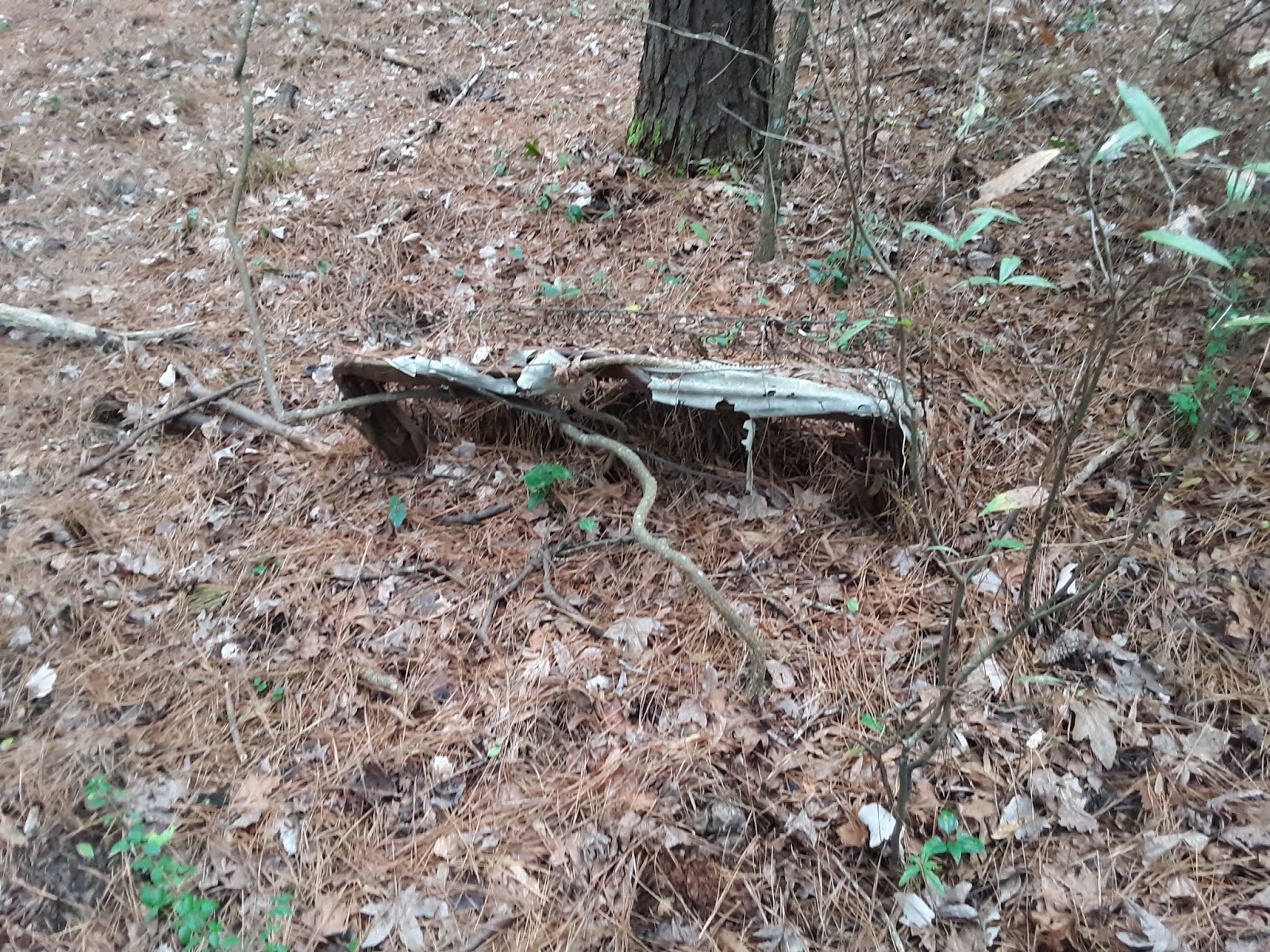
Restoration Park is probably less an example of ecological “restoration” or plans for a full return to the watershed’s original conditions.  It appears to be more of an example of ecological “rehabilitation” to recover many of the ecological characteristics of this watershed area.  Gravel and sand pits that were first dug over a century ago and then abandoned decades ago had been filled since then with waste and dump materials.  Although efforts to clear and remove debris and dump items have occurred, heavy rains there will continue to unearth and reveal remnants of waste disposal.  A few yards from one trail there, I spotted what seemed likely was an automobile seat with metal springs dangling out wildly from it.  

Along the banks of a few small streams could be seen plastic bags half buried in the sand or twisted in the roots and branches of bushes.  Bolden in her AP article explains that this contradiction is part of the unique experience of visiting Restoration Park.  The park displays how nature can be harshly affected by humans, and how these damaged and degraded lands places can be reclaimed, if only over time and with continuing expense.

There are at least a few other parks in the USA and abroad that incorporate multi-purpose watershed restoration or rehabilitation goals that include environmental education and recreational opportunities.  Robert Frank’s 2012 book, Environmental Restoration and Design for Recreation and Ecotourism, explores five case studies of successful regenerative landscape design projects.  The repair of a degraded watershed in the Las Vegas area and creation of the Clark County Wetlands Park there offers perhaps closer parallels to Restoration Park in West Monroe.

Wetlands restoration or rehabilitation is critical to a state like Louisiana, especially in its coastal and marshland areas.  There are often many complex causes and consequences for wetland and watershed degradation.  Restoration Park is just one particular type of rehabilitated brownfield or watershed degradation, and an undertaking that demanded less expensive and more manageable approaches than many damaged watersheds.  Town and cities across this region of the country need to consider basic EPA wetlands recovery principles.  These include 1) identifying previous and ongoing causes for degraded watersheds and possible potentials within these communities, 2) having affected stakeholders involved throughout this discovery of problems and potentials and in the development of clear, achievable and measurable goals, 3) exploring efforts undertaken elsewhere that may be similar to and useful for confronting challenges faced there, 4) focusing on more feasible and sustainable approaches, 5) trying to develop a multi-disciplinary and skilled team of volunteers and partners, 6) better understanding native flora and fauna and approaches to encourage their re-emergence, and 7) continuing to monitor changes and adapting plans and actions where necessary.  

The most important factor for successful wetlands and watershed rehabilitation projects seems to be a founding group of very committed local citizens who refuse to accept the current state of damaged or abused lands.  Without this recognition of a problem and driving force for change, other steps toward actual land rehabilitation can’t be taken.  

One of many tree markers along trail                Office of Ouachita Green at Restoration Park